
By Ziyara.io Last updated October 8, 2026
On this page
You have taken family and friends to Umrah twice. Both trips went well, people still talk about them, and now someone at the mosque says what you have been thinking yourself: you should do this for a living.
So you do the sum on the back of an envelope. Forty-five pilgrims at €1,490 is €67,050 for a single group. That is where most plans go wrong, because almost none of that money is yours.
The short answer: yes, an Umrah agency can be a good business, but the profit is in the volume, not in the first group. In the worked example below, the agency keeps about €159 of a €1,490 package, needs 149 pilgrims a year to cover its running costs, and ends a first year of three groups €2,070 short. The fourth group is the one that pays. The free business plan workbook runs the same calculation on your own numbers.
What one pilgrim really earns you
Revenue is the wrong number to look at. Most of what a pilgrim pays leaves again for the flight, the hotels, the visa and the bus:
| Per pilgrim, quad room | |
|---|---|
| Selling price | €1,490.00 |
| True cost: flight, hotels, visa, transport, guide | €1,280.00 |
| Buffer for currency and surprises (4%) | €51.20 |
| Margin | €158.80 |
That is just under 11% of the price, and it is normal for this business: margins of 10–15% are common. The cost figure comes from our full cost breakdown for a group of 45 travelling from Europe. Yours will differ, which is the point of doing the sum yourself.
What the agency costs to run
The second half of the plan is everything you pay whether a group travels or not. For a small agency with a modest office and part-time help, a year could look like this:
| Running cost | Per year |
|---|---|
| Licence, legal and insurance | €3,000 |
| Office and utilities | €4,800 |
| Staff (part-time) | €9,600 |
| Marketing | €2,400 |
| Software and tools | €708 |
| Accounting and bank fees | €1,800 |
| Other | €1,200 |
| Total | €23,508 |
These are example figures, not a market average. Licence and insurance alone vary enormously from country to country, so replace every line with a real quote. And notice what is missing from the table: your own pay. Whatever the plan leaves at the bottom is what the owner earns, before tax.
The break-even: 149 pilgrims
Divide the running costs by the margin: €23,508 ÷ €158.80 = 148.04. The 149th pilgrim is the first one who earns you anything. With groups of 45, that is 3.3 groups, so a first year of three groups ends just under the line.

| Groups in the year | Pilgrims | Net profit |
|---|---|---|
| 2 | 90 | −€9,216 |
| 3 | 135 | −€2,070 |
| 4 | 180 | €5,076 |
| 6 | 270 | €19,368 |
| 8 | 360 | €33,660 |
The table shows where the money is. Running costs barely move, so each additional full group adds €7,146 to the result. An agency is a fixed-cost business, and its profit sits in groups four to eight.
Three numbers that decide the year
The price. "Fifty euros cheaper, to win the first group" costs 135 × €50 = €6,750 over the year. The loss grows from €2,070 to €8,820.
The fill. Travel with 35 pilgrims per group instead of 45 and the bus and the guide are shared by fewer people. The true cost rises to €1,317, the margin falls to about €120, and three groups end the year about €10,900 down.
The running costs. Start from home, without an office and without staff, and they fall to €9,108. Break-even drops to 58 pilgrims, and the same three groups leave €12,330.
That third number is the argument for starting lean: one person, one phone, a name people trust, and an office only once the groups are paying for it.
Profit is not cash
A plan can be profitable on paper and still run out of money in month four. Flight and hotel deposits fall due before your pilgrims' last installments arrive. In the example:
| Cash needed before pilgrim money arrives | |
|---|---|
| Company registration and licence | €2,000 |
| Website, printed material and first marketing | €2,500 |
| Supplier deposits due before installments arrive | €12,000 |
| Contingency (10%) | €1,650 |
| Cash required | €18,150 |
Take a deposit at registration and date the installments ahead of your supplier deadlines, and the third line shrinks. Managing installments and payments shows how to set that schedule, and the step-by-step launch roadmap covers what belongs in each bucket.
What makes it a good business
- Demand that comes back. Umrah is an act of worship, not a holiday trend, and many pilgrims go more than once. Saudi Arabia's Pilgrim Experience Program aims to raise capacity to 30 million Umrah pilgrims a year by 2030.
- Customers arrive through trust. A group that comes home satisfied fills the next one. That is the cheapest marketing in travel, and the marketing guide shows how to build on it.
- You are paid before the trip. With a sound installment plan, pilgrims' money arrives ahead of most supplier payments.
- Costs do not grow with the groups. The same office, the same licence and the same software serve three departures or eight.
What makes it hard
- A thin margin forgives very little. One seat left empty after the airline's name deadline costs about €650 in our example, which is the margin of four pilgrims who did travel.
- You depend on partners you do not control: the Saudi operator, the airline, the hotels, and rules that change from one season to the next. Nusuk rules for Umrah agencies covers what applies now.
- You are responsible for people. Elderly pilgrims, first-time travellers, a lost passport at two in the morning. While a group is away, someone at the agency is on call.
- The year is uneven. Demand gathers around Ramadan and the school holidays, and so does the cash.
- The paperwork grows with every pilgrim. A passport, a visa file, a bed, a seat and a payment plan each, 135 times over. This is the work that either costs you a salary or gets organized properly: see why agencies stop running groups on Excel.
When it is not a good idea
- Nobody knows you yet. Winning strangers through advertising has to be paid for out of €159 per pilgrim.
- You do not have the cash for the deposits and would pay this group's suppliers with the next group's money. That is how agencies collapse and pilgrims lose their savings.
- Your plan only works at a price below everyone else's.
- You need a salary from it in the first year.
- You cannot be reached while a group is travelling.
If none of these applies to you, the numbers above are a reason to start carefully, not a reason to stay away.
Where Ziyara fits
Ziyara is the "software and tools" line in the plan above: the Starter plan at €59 a month, which is €708 over the year (less when billed yearly). It will not make a thin plan profitable. It is built for the last point in the list of difficulties, so that registration, passports, rooming lists, flight manifests and payments for 135 pilgrims stay within reach of one or two people. The Cost Calculator is included on every plan, so you know the margin per pilgrim before a price goes on a poster. On the Professional plan each group's expenses are recorded against it, and the financial dashboard shows profit per group while you are still selling.
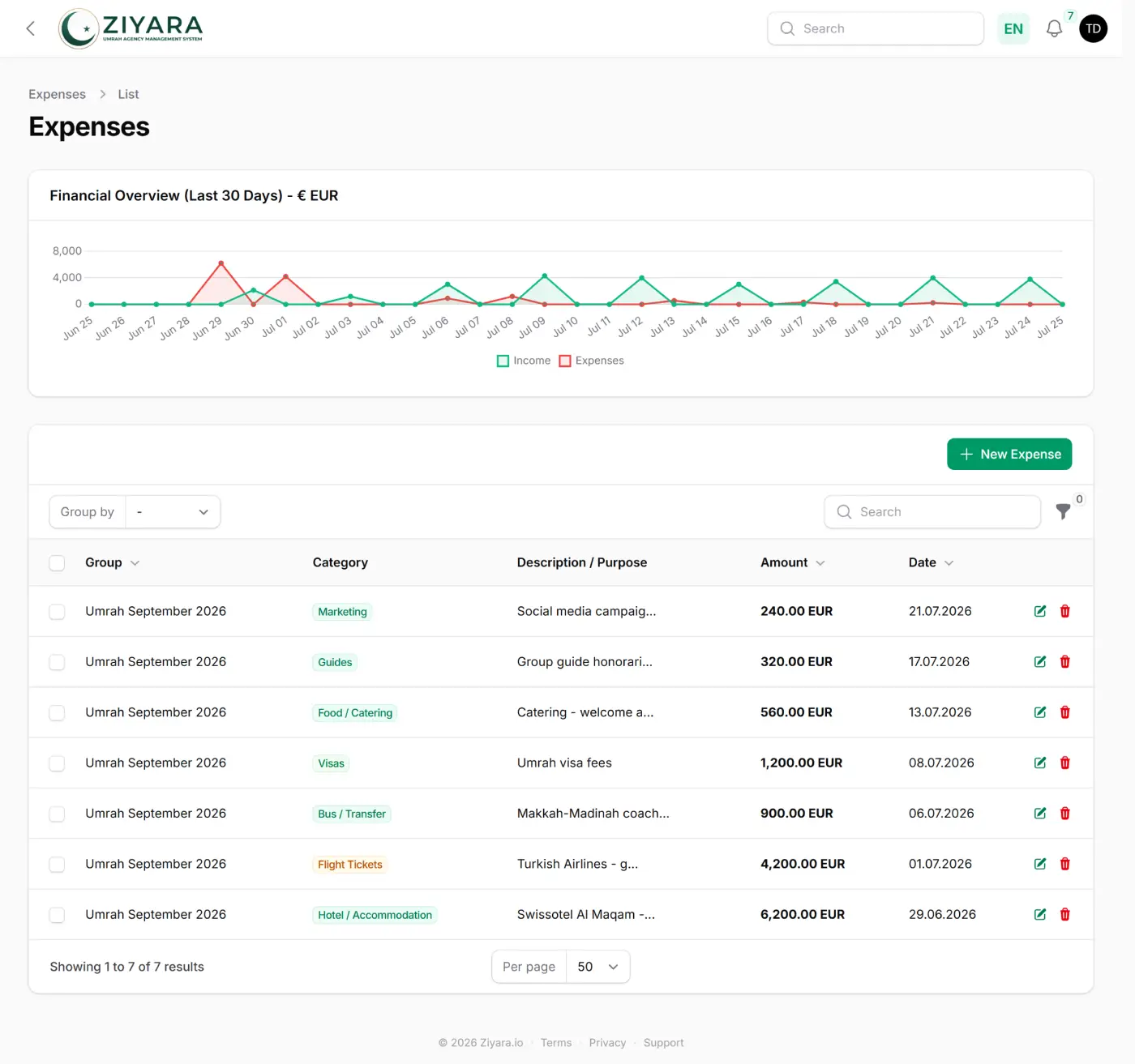
The free trial covers 100 pilgrims and two groups for 30 days, with no credit card. If you are comparing systems, the buyer's guide to Umrah agency software lists what to check.
Frequently asked questions
Is an Umrah travel agency profitable?
It can be, once the volume is there. Margins of 10–15% per package are common, so the profit depends on how many pilgrims travel compared with what the agency costs to run for a year. In our example the agency needs 149 pilgrims a year to break even and earns about €19,400 with six groups of 45.
How much does an agency earn per pilgrim?
In the worked example, €158.80 on a €1,490 quad package: just under 11% of the price, after a 4% buffer. Double and triple rooms priced from their real cost raise it. Empty seats and discounts lower it.
How many pilgrims does an Umrah agency need to break even?
Divide your yearly running costs by your margin per pilgrim. With €23,508 of costs and a margin of €158.80 the answer is 149 pilgrims. Without an office and staff it is 58.
How much money do I need before the first group?
Enough for company setup, the launch, and every supplier payment that falls due before your pilgrims' installments arrive, plus a contingency. In the example that comes to €18,150. A deposit at registration reduces it.
Is there a free business plan template for an Umrah agency?
Yes. The business plan workbook on our templates page is a free Excel file in seven languages. It works out the margin per pilgrim, the break-even point, a table for two to eight groups a year and the cash you need at the start. No sign-up is needed.


